
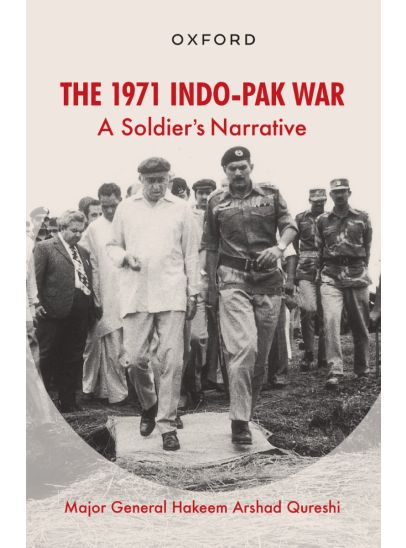
The 1971 Indo-Pak War: A Soldier's Narrative
E-Book
Author: Major General Hakeem Arshad Qureshi
PKR 400 (Recommended retail price)
In stock
- +
ISBN 9789697347292
Category(s) History
Description

General Qureshi’s book forces us to look objectively at the part of our past that we have ignored and tried to forget and I think he has done the Army and the Nation a great service by using his experience to interpret the great tragedy of 1971…. The book, in my opinion, should be compulsory reading for all students of military history.

                                                                           – Gen. Jahangir Karamat, former COAS Pakistan Army


There is much in this book for the historians and the political scientist, but at a purely human level, this is a story, of a typically undemonstrative ocer and his love for his men.

                                                                                               – M.A. Niazi, The Nation, 27 December 2002


The book to my mind is a commendable eort by all standards. It needed a strong will and courage to write this book.... I urge all those who read this book, to read the last chapter of the book namely ‘Concluding Observations’ three times over. It will give you an insight into the tormented soul of the author.

                                                                       – Lt.-Gen. Muhammad Iqbal, former Governor of Punjab

rights Rights World
publications Year of Publication 2024
binding Binding E-Book

Author Description

Commissioned in 1954, Maj.-Gen. Hakeem Arshad Qureshi's formative years were spent in an infantry battalion 1 Pathan (now IIFF) and the Special Services Group (SSG-Commandos of the Pakistan Army) which he subsequently commanded. He wore Khaki for thirty-nine years and held a number of Staff and Command positions including that of the prestigious Desert Hawks Division. He commanded an infantry battalion (26 FF) in East Pakistan (Saidpur-Rangpur-Dinajpur) and led it through the 1970 general election, the civil disobedience movement, the insurgency, the counter-insurgency and the 1971 war, earning a Sitara-i-Jurat in the process. His appointment as Director General Pakistan Rangers, made him responsible for the 1,400 miles long border with India-from the foothills of the Himalayas to the Rann of Kutch, terminating at Sir Creek. On retirement from the Army in 1990, he was appointed member of the Punjab Public Service Commission, retiring from this position in 1995.